Practical guide
Bunkers and fortifications on Hel: trails and maps guide
Bunkers and fortifications on the Hel Peninsula. A practical guide to trails, maps and Second World War sites near Jastarnia and Hel.
The main fortifications of the Hel Peninsula cluster in two places: the Jastarnia Resistance Centre with four pre-war shelters (Sokol, Sabala, Saragossa, Sep) about 3 km west of central Jastarnia, and the Hel tip, where the Museum of Coastal Defence operates by the Schleswig-Holstein battery and the Laskowski battery position. The map below shows both complexes and the base in Jastarnia; further on you will find trails, hours and routes. On a rainy day the fortification museums also make good shelter (see indoor attractions).
- Jastarnia Resistance Centre (Fortifications open-air museum): Four pre-war combat shelters: Sokol, Sabala, Saragossa and Sep, about 3 km west of central Jastarnia.
- Museum of Coastal Defence in Hel: Schleswig-Holstein battery and the Laskowski battery position at the Hel tip.
- Apartment Zdrojowy 323 (Jastarnia): Reference point: base at Hotel Dom Zdrojowy, between the two fortification complexes.
The Hel Peninsula as a fortified area
The Hel Peninsula is not only a strip of beaches and forests, but also a stretch of the Polish coast that had key military importance before the war. Historical records indicate that in 1936, by decree of the President of the Republic, the peninsula was recognised as the Hel Fortified Area, which opened the way to building a large fortification system on the spit and the nearby waters. In the following years, heavy combat shelters, coastal artillery batteries and a network of field fortifications were built here to defend access to the Gdansk Bay and Gdynia.
After the war broke out, Hel became one of the longest-defended sections of the Polish coast. Historical military records indicate that the Hel Fortified Area surrendered only on 2 October 1939, a few days after the fall of Warsaw. Historical military records show that the defence was managed by Navy units, and an important role was played, among others, by the pre-war 31st Battery named after Heliodor Laskowski, with Bofors guns of 152.4 mm size, which exchanged fire with the battleship Schleswig-Holstein, among others.
Today the traces of those events are not only single bunkers hidden in the forest. Thanks to the work of local museums and authorities, trails have been created that lead through the most important structures. The Hel Fortification Trail, the path of the Fortification Open-Air Museum in Jastarnia and the Northern Kashubia Military History Trail together form a kind of detailed, in-the-field map of the Second World War in this region.
The Hel Peninsula from the inside arranges the geographical context well in your head; this text adds a military layer to it.
Osrodek Oporu Jastarnia, four shelters in the heart of the spit
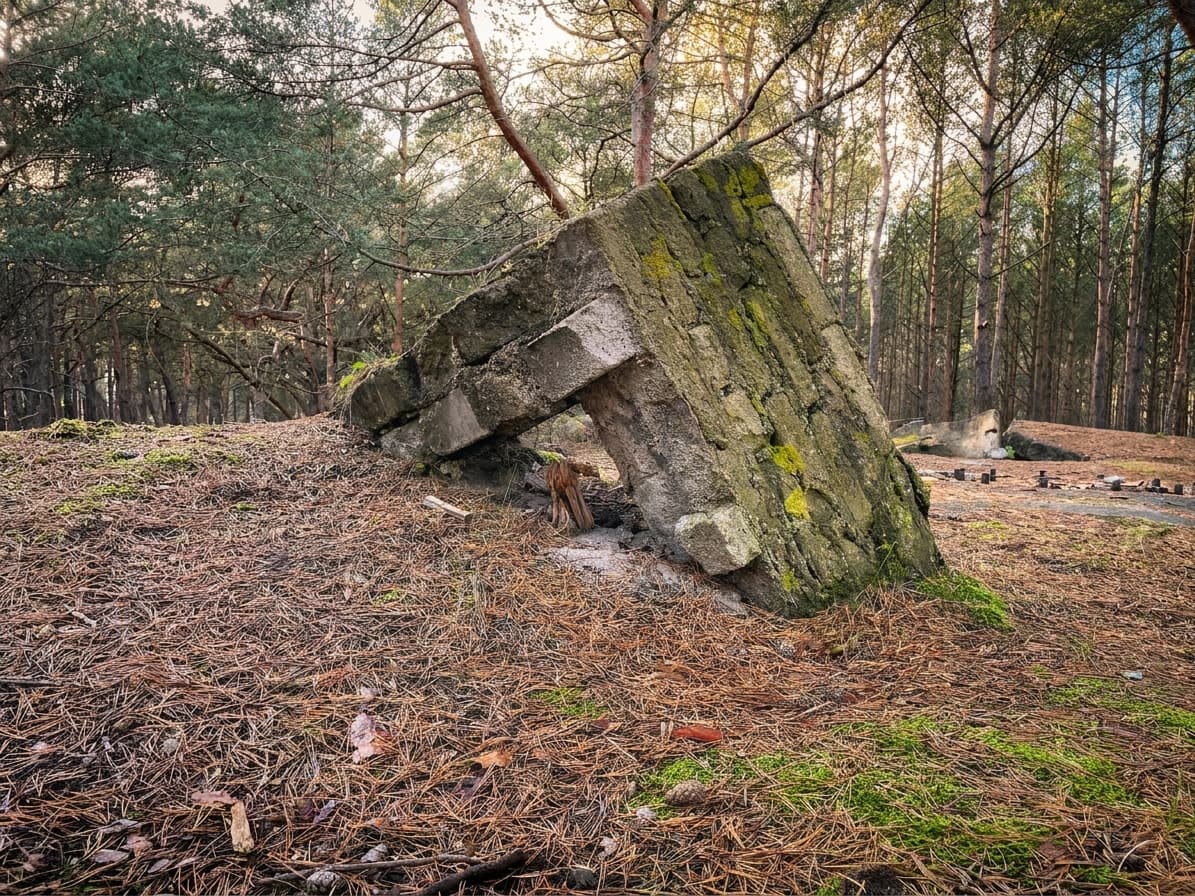
Osrodek Oporu Jastarnia is the most important, still readable fragment of the pre-war fortifications on the stretch between Jastarnia and Kuznica. Located about 3 kilometres from the centre of Jastarnia towards Kuznica, the complex was built in 1939 as part of the defence of the Hel Fortified Area. The complex was designed by Majors Schmidt and Dragula, and the core of the defence was to be four heavy reinforced-concrete combat shelters, in which anti-tank guns in armoured cupolas were planned, a solution considered very modern at the time.
The shelters were given the names Sokol, Sabala, Saragossa and Sep. Sokol stands by Puck Bay near the Maszoperia campsite, Sabala served as a command shelter in the forest by the railway line, Saragossa lies between Sabala and Sep, and Sep, the most advanced towards the open sea, is on the beach. Materials from Pomorskie.travel stress that all four shelters have similar technical parameters, although Sep stands out with the thickest walls, from about 125 to 330 millimetres, and a ceiling 160 centimetres thick.
The museum's official website indicates that since 2005 these structures have hosted the Second Polish Republic Fortification Open-Air Museum named after Rear Admiral Wlodzimierz Steyer. Around the shelters, anti-tank and anti-infantry obstacles have been rebuilt, educational boards prepared and a short educational path laid out. It is a place where in a single walk you can see an overview of Poland's defensive preparations just before the war.
For guests from Jastarnia it is an ideal half-day destination. Osrodek Oporu can be reached on foot or by bike, as the local routes on the Czas na rower service describe, among others. Such a trip can be combined with the gentle walking programme described in off-season Hel with children.
The Hel Fortification Trail: a blue spine and colourful spurs
The thickest cluster of bunkers is at the end of the peninsula. The Hel Fortification Trail, as described by Pomorskie.travel and authors of cultural routes, is a route that links the most important elements of the Hel Fortified Area and the post-war batteries into one clear loop. The trail starts at the PKP railway station in Hel and ends near the cape, forming a main path marked in blue about 10 kilometres long.
Shorter routes branch off this "spine", the so-called spurs, in various colours and lengths. The red trail leads to the fortification structures of the very tip of the Hel Peninsula, including the remains of artillery batteries. The yellow trail leads to the 21st anti-aircraft battery, the black one to the remains of a German anti-aircraft battery on the beach, the orange one to the 33rd Danish battery, and the green one to the Swedish Hill. The brown trail to the dunes with anti-aircraft defence battery positions completes the set.
The Wiedzma w ruchu service's trail description suggests planning a whole day to walk the blue route and selected branches. Although the distance of about 12 kilometres does not seem large, every now and then there is a reason to stop longer: the Laskowski battery, the Coastal Defence Museum, the fire control towers, the remains of coastal artillery positions. Trail maps are available on boards, in the museum and as PDF materials prepared, among others, by local hotels.
If someone likes the combination of history and an intensive walk, the Hel Fortification Trail is a ready answer to the question of what to do for a whole day, not only in good weather.
The Northern Kashubia Military History Trail: a wide regional map
Bunkers and fortifications on the Hel Peninsula do not function in a vacuum. A local tourist organisation has created the Northern Kashubia Military History Trail, which is mainly a driving route but is also suitable for cycling and walking in sections. The official trail description states it covers over 80 points connected with the war and military heritage of the Puck district, from the small cape at Rozewie and the Puck area through to Hel and Jastarnia.
The route is built on the principle of a spine and spurs, similar to the trail in Hel. The main axis, marked in blue, is about 10 kilometres long and runs from the PKP station in Hel to the area of the cape, linking, among others, the Coastal Defence Museum, the Schleswig-Holstein battery open-air museum and other structures. The spurs lead to points away from the main route, such as the castle in Krokowa, the fortifications in the Puck area or the open-air museum in Jastarnia.
From a practical point of view it is a good "meta map" of the region. If you are planning a few days on the Hel Peninsula and the surrounding area, you can treat the Military History Trail as a list of inspiration and pick the sections that suit the age and interests of the household. Combining a day on the trail in Hel, half a day at Osrodek Oporu Jastarnia and a shorter trip to Krokowa already makes a mini historical route for several days.
In planning, the guide a one-day family triangle helps, showing how to sensibly spread your energy between Wladyslawowo, Jastarnia and Hel.
How to arrange a bunker day with a base in Jastarnia
From the point of view of a guest sleeping in Jastarnia, the most important thing is not to treat the bunkers as a "tacked-on" point after the beach. It works much better to think of them as a separate axis of the day. For Osrodek Oporu Jastarnia, we recommend setting aside a separate block, ideally a late-morning or late-afternoon one, when the sun is lower and the forest gives shade. The walk from the town centre takes about 40 to 45 minutes one way, or 15 to 20 minutes by bike, depending on pace.
A day in Hel is worth dividing into three parts. In the morning, a walk along a stretch of the blue trail to the Coastal Defence Museum and the Laskowski battery; the middle of the day on the beach or in the harbour; and the afternoon on selected "spurs", for example reaching the 33rd Danish battery or the anti-aircraft defence positions on the dunes. It is a plan that works well for older children and teenagers, especially if you combine it with the attractions from the guide teen attractions on Hel when they say Hel is boring. The middle of such a day on the cape can also be spent watching for wild seals in their natural habitat.
From Jastarnia to Hel it is most convenient to travel by train, as the logistics guides in the series the Hel Peninsula without a car describe. This means you do not have to go back for the car, and the day can end with a calm return by rail and a short walk to the hotel.
Bunkers and fortifications also appear in Polish crime series - if you are planning a longer stay, we suggest pairing this historical layer with the Hel Peninsula film trail. The same forests and bunkers serve as backdrops for many frames, letting you see them from two different angles in a single trip. Photographers will also appreciate the guide to 10 golden hour locations, which describes how the evening light works around fortifications and dunes.
In the evening it is good to have a place where you can rest a moment, look through the photos of maps and boards you took, tell the children what they saw and plan the next outing. Apartament Zdrojowy 323, a studio in Jastarnia at Hotel Dom Zdrojowy, plays that role, where after a day in the forest and the concrete fortifications you can return to a quiet room with a sea view.
Sources and references
- https://jastarnia.pl/szlak_historii_militarnej2.html
- https://pomorskie.travel/punkty-poi/osrodek-oporu-jastarnia-w-jastarni/
- https://www.jastarnia.info.pl/atrakcje/bunkry-i-torpedownia-w-jastarni
- https://www.czasnarower.pl/trasa/4013
- https://kaszubypolnocne.pl/szlaki/szlak-historii-militarnej/
- https://pomorskie.travel/artykuly/szlak-fortyfikacji-w-helu/
- http://www.szlaki.sgpm.krakow.pl/szlak-fortyfikacji-w-helu/
- https://www.wiedzmawruchu.pl/fortyfikacje-helskie/
- https://www.znajkraj.pl/fortyfikacje-mierzei-helskiej
- https://hotelhel.com/wp-content/uploads/2019/07/TrasyRoweroweHel.pdf
- https://pl.wikipedia.org/wiki/Rejon_Umocniony_Hel
- https://motylarnia-hel.pl/2024/11/14/fortyfikacje-polwyspu-helskiego-historia-i-atrakcje-dla-turystow/
Frequently asked questions
Do the bunkers on the Hel Peninsula date only from the Second World War?
No. On the Hel Peninsula you find both fortifications from the Second Polish Republic period, used in the 1939 campaign, and post-war structures from the Cold War. The Hel Fortified Area was established by presidential decree in 1936 and included, among others, the battery named after Heliodor Laskowski with Bofors guns of 152.4 mm calibre, built between 1935 and 1939. In the forests on the cape, positions of this pre-war battery and other shelters from the 1939 defence of Hel have survived. After the war, further structures were built on the peninsula, including coastal artillery batteries such as the 27th and 13th, which arose as part of Cold War armament, not during the Second World War, although to a layman they look very similar. Trails and maps usually show both types of structure, but information boards clearly distinguish the period of their construction.
Where exactly is Osrodek Oporu Jastarnia and which bunkers belong to it?
Osrodek Oporu Jastarnia, the Jastarnia resistance point, lies about 3 kilometres from the centre of Jastarnia towards Kuznica, in the widest part of the Hel Peninsula. It is a pre-war fortification complex meant to be an important defensive point of the Hel Fortified Area. The core of the defence is four heavy reinforced-concrete combat shelters: Sokol, Sabala, Saragossa and Sep, supplemented by light shelters and reconstructed anti-tank and anti-infantry obstacles. Sokol lies by Puck Bay near the Maszoperia campsite, Sep on the beach on the open sea side, Saragossa between Sabala and Sep, and Sabala serves as a museum shelter in the forest by the railway line. Since 2005 these structures have hosted the Second Polish Republic Fortification Open-Air Museum named after Rear Admiral Wlodzimierz Steyer, with information boards and an educational path.
What is the Hel Fortification Trail and how do you use its map?
The Hel Fortification Trail is a well-marked tourist route that links the most important bunkers, shelters, fire control towers and artillery positions on the cape. According to the Pomorskie.travel description, the main path, marked in blue, is about 10 kilometres long and forms an incomplete loop starting at the PKP railway station in Hel and ending near the cape. Shorter routes branch off this axis, the so-called spurs, marked in other colours, leading to specific structures such as the 21st anti-aircraft battery, the 33rd Danish battery or the anti-aircraft artillery positions on the beach. Trail maps are available on boards in the field, in Coastal Defence Museum materials and as PDFs prepared, among others, by local authorities and hotels. It is worth photographing the map at the start of the route.
Can you walk the bunker trail from Jastarnia without a car?
Yes, the Hel Peninsula is one of the best places in Poland for sightseeing military sites without a car. Hel can be reached by train from Jastarnia, and the Fortification Trail starts practically at the station. The main, blue route is about 10 to 12 kilometres, so it can be walked in one day, with breaks to visit the Laskowski battery, the Coastal Defence Museum and the fire control towers. Osrodek Oporu Jastarnia is closer, about 3 kilometres from the centre, and can be reached on foot along forest paths or by bike, as both the town military history trail of Jastarnia and the local cycle routes describe. When planning the whole day it is worth using the practical tips from the guide on a week on Hel without a car, which shows how to combine train, bike and walking sections.
Are the bunkers on Hel safe for families with children and pushchairs?
Most of the structures on the trail are accessible from forest roads and paths, but not all are pushchair-friendly. Bunker entrances often have steep stairs, narrow passages and uneven ground, so for small children it is better to use carriers than classic pushchairs. The Fortification Open-Air Museum in Jastarnia is partly adapted to family traffic. Around the structures there are hardened paths, educational boards and space to manoeuvre a pushchair, but the interiors of the shelters themselves require caution. On the Hel Fortification Trail some approaches lead through dunes and forest tracks, so it is best to choose shorter sections and be aware of equipment limitations. Inspiration is also worth seeking in the guide on Hel friendly to pushchairs and people with limited mobility, which points to easier routes.
Is there a single bunker map of the Hel Peninsula worth carrying with you?
Rather than a single, ideal map, it is better to treat the subject as a set of complementary sources. The Hel Fortification Trail has its own maps and diagrams, available on boards and in brochures at the Coastal Defence Museum. Osrodek Oporu Jastarnia has its own educational path with layout plans of the Sokol, Sabala, Saragossa and Sep shelters. In addition, the Northern Kashubia Military History Trail, described by a local tourist organisation, links over 80 military structures in the Puck district into one system of marked points, from Rozewie through Hel and Jastarnia. In practice it is worth photographing the boards at the start of the trail, downloading a PDF of the Hel fortification routes and having a general map of the Hel Peninsula on your phone. The rest will be filled in by the local boards and descriptions at the structures.
How much time should you plan for the bunkers and how do you fit them into a Jastarnia stay?
For Osrodek Oporu Jastarnia it is good to set aside a minimum of 2 to 3 hours, especially if you want to go inside the Sabala shelter and read the boards calmly. The whole Hel Fortification Trail is material for a full day, because the route in the forest alone is about 10 to 12 kilometres, with museums, gun positions and viewpoints along the way. If Jastarnia is the base, a sensible layout is a bunker day in Jastarnia, a bunker day in Hel and a break day for lighter activities, for example bikes or forest walks described in the guide on nature and microclimate of the Hel Peninsula. In a week-long stay you can easily weave military sightseeing in alongside beach time and watersports, and thanks to Jastarnia's position in the middle of the spit you do not lose hours on travel.